

Soluna Holdings, which operates eco-friendly data centers hosting Bitcoin mining and emerging AI infrastructure, experienced a surge in second-quarter revenue alongside a dip in overall profitability.
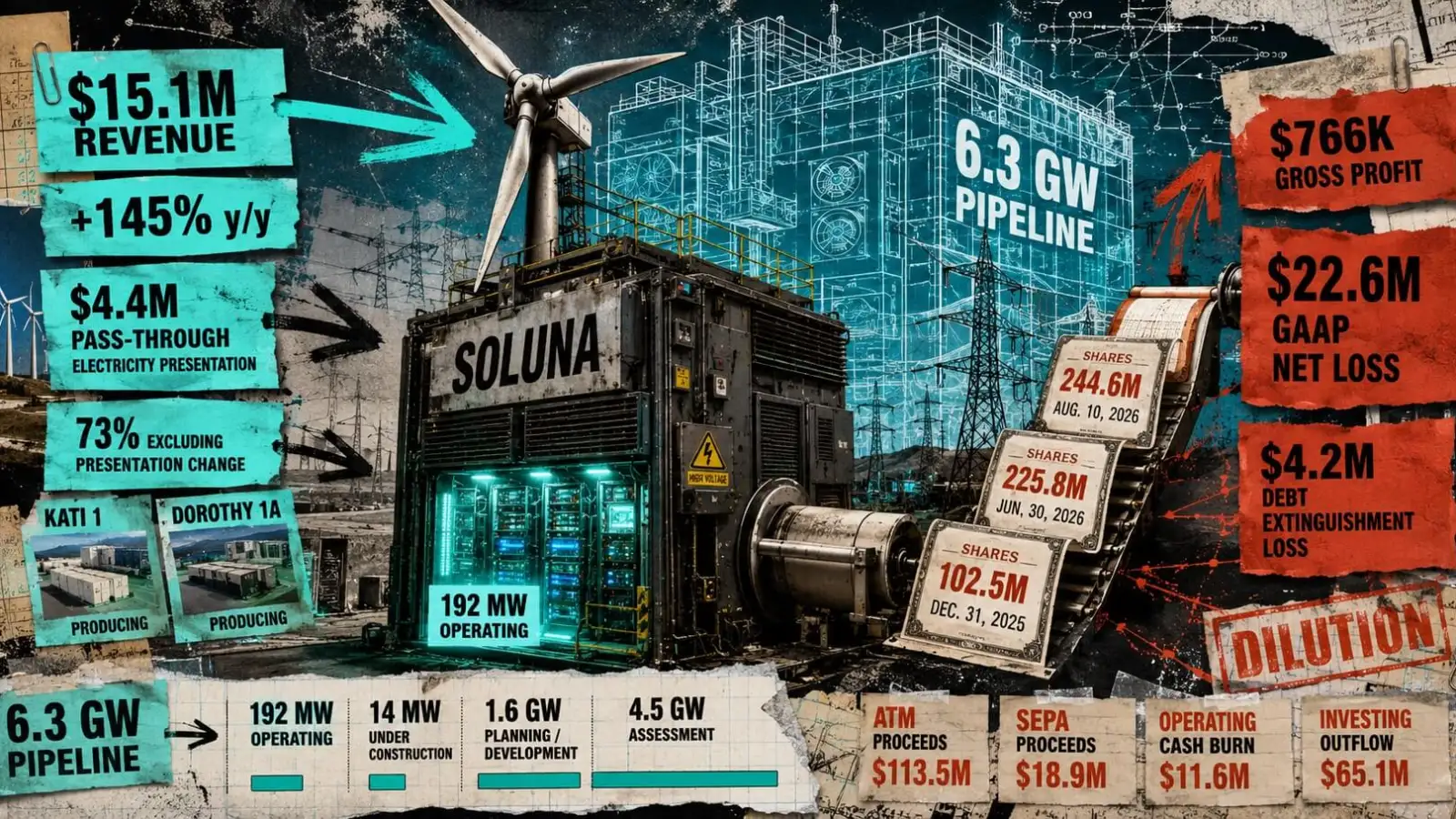
The firm posted $15.1 million in revenue for the quarter ending June 30, representing a 145% jump from the $6.2 million recorded during the same period last year. A shift in how pass-through electricity costs are presented added $4.4 million to both revenue and cost of revenue, though this adjustment did not impact gross profit, operating loss, or net loss. Stripping out this accounting change, revenue still climbed by 73%.
Operationally, Project Kati 1 finalized construction on 48 MW of capacity, yielding its first positive site gross profit of $82,000. Meanwhile, Project Dorothy 1A brought in $2.9 million in revenue and $795,000 in gross profit.
Despite these gains, consolidated gross profit plunged 60% compared to the first quarter, dropping to $766,000. Soluna blamed the decline on $1.5 million in maintenance expenses at the newly acquired Briscoe Wind Farm, startup costs for Kati 1, and depreciation charges that took effect before the facilities could achieve their full revenue-generating potential.
The company’s consolidated GAAP net loss expanded to $22.6 million, up from a $17.9 million loss in the first quarter and a $7.8 million loss a year earlier. Additionally, the Bitcoin miner reported a $4.2 million loss related to debt extinguishment in its quarterly filing.
To fund its operational needs, acquisitions, and ongoing development, Soluna relied heavily on equity dilution. The company’s outstanding common shares surged by 120%, growing from 102.5 million on Dec. 31, 2025, to 225.8 million by June 30.
In the first half of the year, Soluna raised $113.5 million in net proceeds by selling 74.2 million shares through its at-the-market program. It generated another $18.9 million in net proceeds by issuing 10.2 million shares through a standby equity purchase agreement.
Cash expenditures during the first six months included $11.6 million consumed by operations and $65.1 million in investing outflows. The latter figure includes a net $51.4 million for the Briscoe acquisition and $25.3 million allocated for stakes in Dorothy 1A and 1B.
Following the close of the quarter, Soluna offloaded another 18.8 million at-the-market shares for roughly $23.6 million. This brought its total outstanding share count to 244.6 million as of Aug. 10, marking a 139% increase from the end of the prior year.
Despite Soluna’s strategic pivot toward AI, its active capacity is a fraction of its projected development pipeline. As of Aug. 1, the company claimed a total pipeline of roughly 6.3 GW, yet only about 192 MW—representing roughly 3%—was actually operational across three fully energized locations.
Of the remaining pipeline, 14 MW was under construction at Kati 1, 1.6 GW was in the planning and development phases, and 4.5 GW was undergoing assessment with power utility partners.
The Kati 2 project highlights this disparity between future plans and current operations. This joint venture with Metrobloks is designed to deliver 100 MW of critical IT capacity during its initial phase and another 250 MW in phase two; however, neither phase is currently counted toward active operating capacity.
For the time being, Soluna’s actual footprint consists of 192 MW in operation, paired with more than 6 GW in various stages of construction, planning, development, or evaluation, all supported by a share count that has climbed to 244.6 million.
