

Justin Sun ramped up his ongoing conflict with the Donald Trump-backed crypto project World Liberty Financial on Friday, alleging that its USD1 stablecoin contains administrative capabilities that allow authorized operators to transfer funds out of frozen wallets without the owner’s consent.
On Aug. 21, the Tron founder asserted that World Liberty’s publicly available source code does not match the smart contract currently running on the blockchain. He argued that this inconsistency points to a deceptive deployment, comparing the discrepancy to tactics typically used in “rug pull” exit scams.
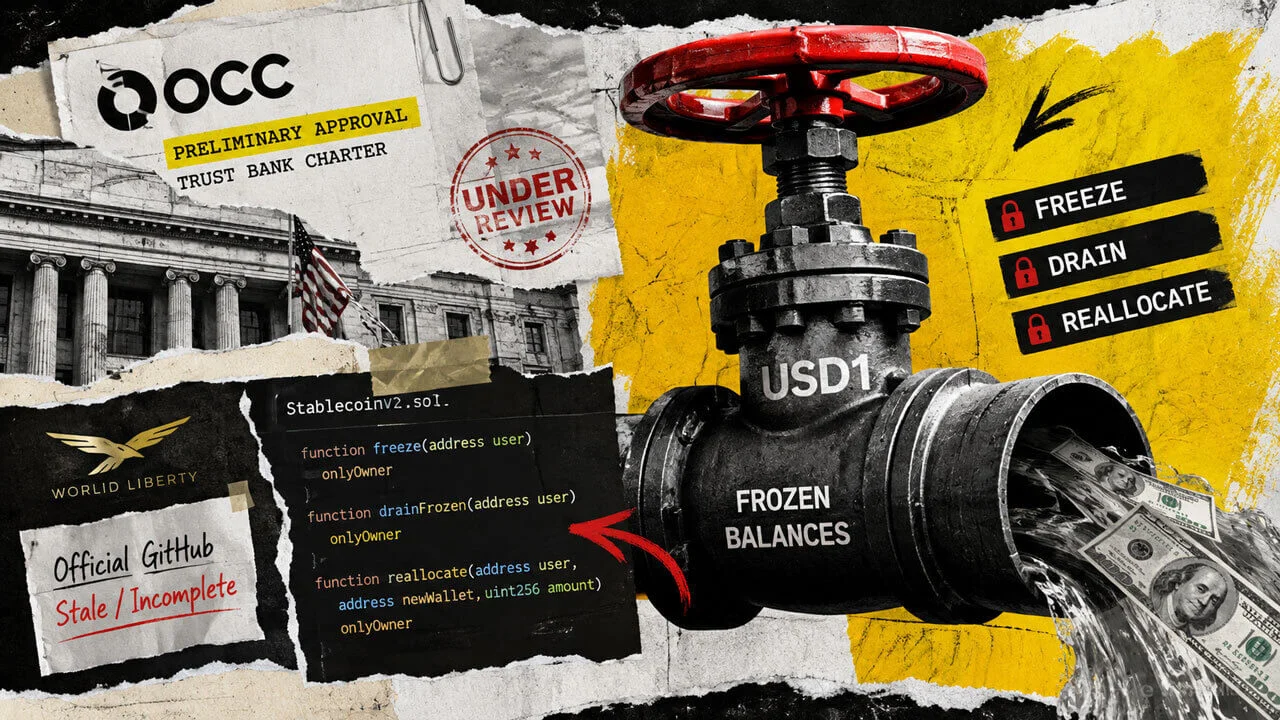
Sun stated that the active USD1 smart contract has the capacity to drain or reallocate token balances once an address has been frozen. Consequently, utilizing cold storage or multisignature wallets would fail to block intervention at the token-contract level. He also alleged that similar administrative privileges were retroactively added to the WLFI token.
According to Sun:
“USD1’s highest-level permissions allow the issuer to move USD1 out of YOUR account into its own wallet — or anyone else’s — without your consent. Cold wallet? Multisig? Doesn’t matter. The authority operates at the token contract level. Nothing you do can stop it.”
Examining the Functionality of USD1’s Active Code
USD1 operates via an upgradeable proxy contract, which transitioned to its current StablecoinV2 implementation on April 5.
This version includes drain and reallocate features designed to act on frozen accounts. A technical review of the smart contract confirms that the drain function transfers the entire balance of a frozen address back to the contract owner, while the reallocate function can move a specified sum from a frozen wallet to a different address.
Neither of these actions requires authorization from the impacted token holder.
This confirms Sun’s technical claim: once an address is frozen, a user’s local custody arrangements cannot override contract-level administrative controls.
However, these functions do not grant random users the ability to access someone else’s USD1 or execute unrestricted transfers at any time. Instead, they are restricted to authorized administrators and can only be executed on wallets that have already been frozen.
The more challenging issue is the discrepancy between the live, deployed contract and World Liberty’s public GitHub repository.
While the project’s GitHub code outlines functions for minting, burning, freezing, and pausing, it does not display the drain, reallocate, or V2 initialization functions present in the active deployment. Because the deployed code is fully viewable on verified blockchain explorers, these features are not hidden from anyone inspecting the live contract directly.
Even so, a developer or investor relying strictly on World Liberty’s public repository would remain unaware of the complete set of administrative powers currently governing USD1.
This distinction is notable because centralized stablecoins typically maintain intervention capabilities. For instance, the issuers of USDT and USDC have the power to freeze or blacklist addresses. Similarly, BitGo—the current technical provider and issuer of USD1—discloses in its terms of service that it may upgrade or freeze USD1, and may permanently lock assets under certain regulatory or compliance scenarios.
While these standard practices make centralized controls unsurprising, they do not clarify why World Liberty’s public code repository remains out of sync with the live contract.
Sun Intensifies His Offensive Amid World Liberty’s Push for Banking Approval
These accusations mark an escalation in a multi-month dispute between Sun and World Liberty.
Sun was an early backer of the project, contributing $45 million to WLFI. However, the relationship soured after World Liberty blocked his token access, accused him of unauthorized asset transfers and attempting to manipulate WLFI’s price, and filed a defamation lawsuit against him. Sun has denied these claims.
The legal battle heated up on Aug. 20, when Sun asserted he had secured a procedural win that would keep his personal claims against World Liberty in federal court.
The following day, Sun expanded his criticisms to target USD1, claiming that the divergence between the live contract and the published code pointed to a fraudulent deployment.
“Anyone in crypto knows exactly what that pattern is,” Sun remarked, comparing the discrepancy to tactics used in rug pulls and claiming World Liberty had previously applied a similar strategy to WLFI.
Currently, there is no evidence indicating that World Liberty intentionally left its repository outdated to deceive users or auditors. Furthermore, the code discrepancy does not suggest any backing issues, reserve deficits, or unauthorized transfers of USD1 from user accounts.
Nevertheless, the timing of these allegations raises the stakes for World Liberty.
Sun’s criticisms surfaced just seven days after the Office of the Comptroller of the Currency (OCC) granted preliminary conditional approval to World Liberty Trust Company. This proposed national trust bank is slated to take over USD1’s issuance, redemption, and reserve management from BitGo.
This preliminary approval is subject to pre-opening conditions and does not yet permit the bank to conduct active operations.
Additionally, USD1 is heading into this transition with a reduced supply. Its circulating supply has dropped by more than $1.3 billion from its February peak of over $5.3 billion, currently sitting at $4 billion, according to data from DeFiLlama.
While this contraction started before Sun’s recent claims and does not prove that users are redeeming assets due to the contract dispute, it means World Liberty is seeking final banking approval at a time when its primary stablecoin is down from its historical highs.
World Liberty has also disputed Sun’s interpretation of their legal proceedings. Chief Executive Officer Zach Witkoff described Sun’s summary of the recent arbitration hearing as “riddled with falsehoods.” Witkoff stated that the court has not issued a ruling and argued that certain claims brought by Sun’s companies must be resolved in arbitration. World Liberty is also seeking to have Sun’s personal claims dismissed.
Ultimately, the dispute centers on a much narrower technical issue than Sun’s framing suggests. He has not proven that USD1 is a rug pull or that its administrative controls were implemented with fraudulent intent.
Nonetheless, the gap in disclosure remains a valid concern: USD1’s live smart contract includes capabilities that are not documented in World Liberty’s public repository, just as the firm works to secure final regulatory approval for a trust bank intended to manage the asset.
